
The Chicken, The Keyboard, and the Critical Photographer: Stepping Off the Beaten Path
By Sankara Yambo
A PICHA community session in March explored what makes a good image. I appreciated this discussion. The facilitators spoke about their practice when shooting, delving into interesting topics such as archiving, intimacy and Nostalgia. It was a topic that piqued my interest, and I was happy to learn.
During a trip to Dar es Salaam earlier in the year, I spoke to a documentary photographer about his practice. His arc involved capturing the environment, an action, a wide shot and a close-up. This was great as it spoke to how you build context, but I was interested in how he decided what was worth capturing. “Curiosity”, he said. He wanted his images to bring the audience to ask questions.
Later in the year, I joined a photo walk in Nairobi and met a gentleman from the UK. As we got into the walk, I asked him about his process. He shot video, and as an architect, captured mostly buildings. He liked it when something simple or mundane happened in the foreground with a building as the backdrop. This got me thinking about composition and the conversation between subject and environment.
These conversations were offering me a gateway into the language of photography beyond aesthetics. I was hoping to deconstruct what kind of thinking went into creating a great image, and I was using these conversations and a bit of research to do it. While mulling over it and scribbling on my whiteboard, it became clear that nothing is devoid of narrative, be it an object, a colour, a material or space; and when put together in a composition, these elements communicate with each other, and in turn with the audience.
The interplay between different elements in a composition come together to make up a story: subject, location, props, framing, lighting, etc. Indeed, stories are all around us, but some effort gives our chosen stories more resonance. If done right, the right mix of elements could make obscure topics visible and uncomfortable topics palatable.
Let’s look at a project where one decides to document the everyday person. Rather than just capture portraits of your subjects, you can play around with different elements to make your story more striking. In Africa, where images of poverty and struggle are perpetuated and almost pushed as the default, using a prop such as a crown on your subjects or a burst of confetti in the shot can challenge that idea.
An image of a subject meditating in the middle of a busy street can highlight the challenge of slowing down in a fast-paced city like Nairobi. An image of a traditionally dressed Maasai man opening a car door for a traditionally dressed Maasai woman can bring up debates around chivalry and misogyny, or traditional dress in urban settings.
Ultimately, the ability to capture photographs that provoke curiosity, discomfort or reflection is likely to spark a conversation and draw more attention to your work.
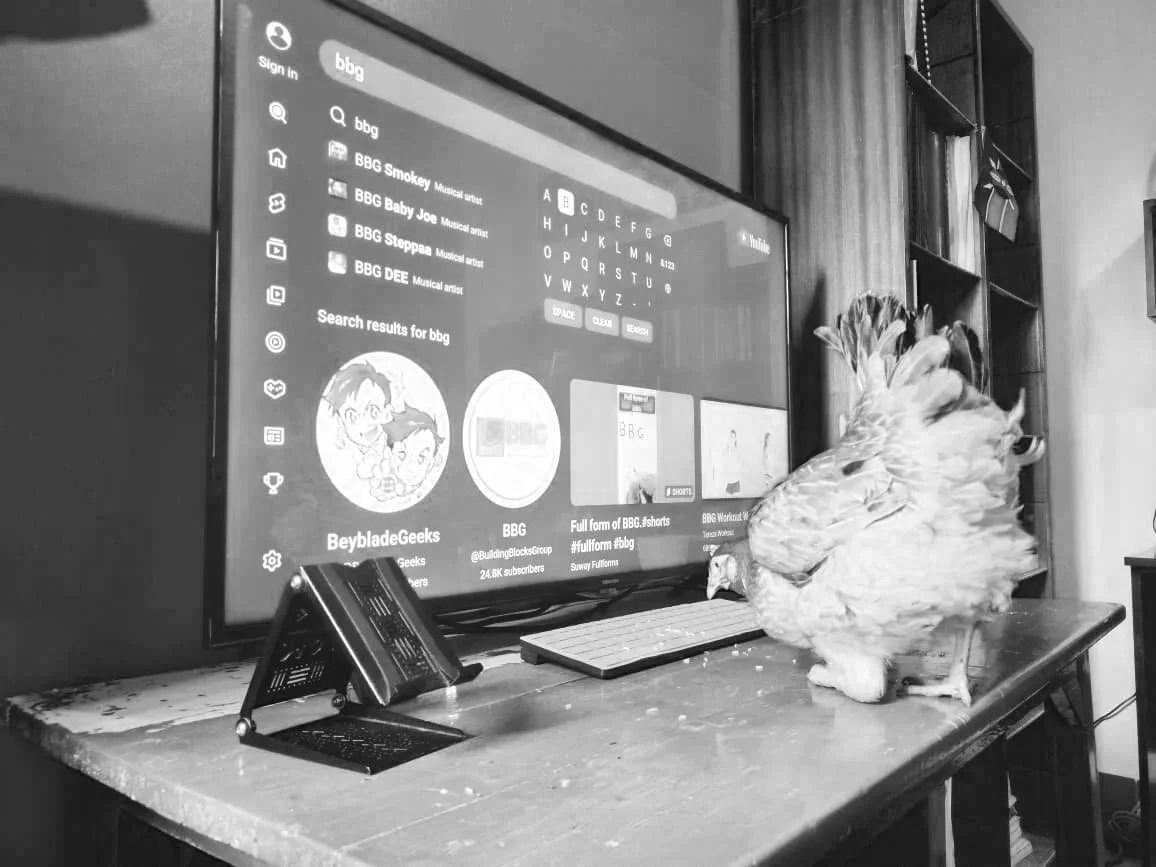
As the saying goes, it is easier said than done, but the lessons come from doing. I recently got the absurd idea of photographing one of my chickens using a keyboard at my desk. The plan was to have the chicken search for something on YouTube or an e-commerce website. I placed rice on the keyboard to make it appear as though the hen was typing as it fed. Ridiculous, I know, especially since the hen pooped almost immediately after I set it down. I did run through several wet wipes but the room still had a slight chicken poop smell. I honestly wasn’t sure I’d be trying this again. Although the shot didn't work out as expected, the experience was so funny that it made it worth my while.
I’d like to encourage other creatives to step off the beaten path and capture concepts that are close to them. For the sport, I’m personally eager to do more experiments like this. Let's see where they lead me.